Tag: privacy

  • Temporary iCloud Email Address (2026): What Works (Hide My Email vs Aliases vs Disposable Inbox)

    Temporary iCloud Email Address (2026): What Works (Hide My Email vs Aliases vs Disposable Inbox)

    Updated January 2026.

    Need a temporary iCloud email address for a signup, verification code, or spam control? Apple doesn’t offer a “temporary iCloud inbox generator” that creates brand‑new @icloud.com inboxes that expire automatically—but you do have several options that achieve the same outcome.

    This guide covers what actually works in 2026: Hide My Email (iCloud+), iCloud Mail aliases, custom-domain addresses, and when it’s smarter to use a true disposable inbox for one-time OTP codes.

    If you want a fast throwaway inbox right now, start here: Anonibox temporary email generator.


    Quick answer: how to get a temporary iCloud email address

    Use this simple decision tree:

    • Best for privacy + recoverability: Hide My Email (iCloud+) or an iCloud alias
    • Best for one-time OTP codes / low-stakes signups: a disposable inbox like Anonibox
    • Best for accounts you’ll keep (password resets later): use an email alias strategy so you stay recoverable: Email Alias (2025)

    If you’re blocked or not receiving emails, jump to: Verification Email Not Received (Temp Mail)? Fix It Fast (2026).


    What people mean by “temporary iCloud email address”

    Most people aren’t literally trying to create a brand-new iCloud inbox that disappears. They’re trying to achieve one of these goals:

    • Don’t share my real email: protect your primary address from spam and tracking.
    • Compartmentalize signups: use different addresses for different sites.
    • Receive an OTP code once: confirm a signup and move on.
    • Stay recoverable: still be able to reset passwords later.

    Apple’s tools (Hide My Email + aliases) excel at privacy with recovery. Disposable inboxes excel at “use once and discard.” You can combine both approaches depending on the situation.


    Option 1: Hide My Email (best Apple-native “temporary address”)

    Hide My Email is Apple’s privacy feature for creating unique, random addresses that forward to your real inbox. It’s part of iCloud+ and works especially well when you want a “throwaway-looking” address that is still manageable and recoverable.

    When Hide My Email is the best choice

    • You want to sign up without exposing your real email.
    • You want to stop the address later (disable forwarding).
    • You want the account to remain recoverable (password resets can still reach you).

    Downsides to know

    • It’s not truly disposable. It’s intended to be managed long-term (which is good for recovery).
    • Some sites treat “relay” style addresses differently. If a platform blocks certain relay domains, you may need an alias or a standard inbox.

    Tip: If you only want a one-time OTP code and don’t care about future recovery, a disposable inbox is faster: Anonibox. If you might keep the account, Hide My Email is often a better fit.


    Important note: “Sign in with Apple” Hide My Email addresses

    When you use Sign in with Apple and choose “Hide My Email,” Apple generates a relay address (commonly ending in @privaterelay.appleid.com) that forwards messages to the verified email on your Apple Account.

    Here’s the key detail most people miss: for Sign in with Apple relay addresses, only emails from designated sender addresses for that app/website are automatically forwarded. That can be good for spam control—but it can cause issues if a company’s support emails come from a different sender address than the one Apple expects.

    Practical advice:

    • If you’re signing up for a service where you might need support later, consider using Hide My Email created from iCloud settings (or an alias), not only the Sign in with Apple relay address.
    • If messages aren’t arriving, switch to an alias or a standard inbox.

    Option 2: iCloud Mail aliases (simple, recoverable separation)

    iCloud Mail supports email aliases: extra @icloud.com addresses attached to your iCloud Mail account. These are great when you want a second (or third) address for signups that still lands in your iCloud Mail inbox and remains recoverable.

    Why aliases are useful

    • Recoverable: password resets and receipts still reach you.
    • Cleaner separation: one alias can be “signups only.”
    • Less friction: no need to manage a second mailbox.

    Downsides

    • Aliases are limited (they’re not unlimited dynamic tags).
    • They’re not “one-time” by default (you manage them like normal addresses).

    If you want to “kill switch” a specific alias when it leaks, aliases are perfect. If you want hundreds of per-site addresses, use an alias strategy or disposable email depending on the use case.


    Option 3: iCloud+ Custom Email Domain (for serious separation)

    If you subscribe to iCloud+, you can also use a custom email domain with iCloud Mail. This is useful if you want privacy and control without depending on a single public provider identity like @icloud.com.

    Best for: long-term identities you control (personal domain), family setups, and reducing provider lock-in.

    Not best for: quick one-time OTP codes (too much overhead for a simple signup).


    Option 4: Use a disposable inbox for one-time signups

    If your goal is a true “temporary email” for an OTP code or download link, a disposable inbox is usually the fastest tool.

    Start: Anonibox temporary email generator

    Best for

    • OTP / verification codes
    • “Send the link to your email” download gates
    • Low-stakes signups you don’t plan to keep
    • Quick access flows (Wi‑Fi portals, giveaways)

    Not recommended for

    • banking, healthcare, government portals
    • paid subscriptions, invoices, receipts
    • any account you might need to recover later

    If you’re deciding between “temp mail” and “alias,” read: Is Temp Mail Safe? (2026) and How Does Temp Mail Work? (2026).


    Hide My Email vs iCloud alias vs disposable inbox

    Option Best for Recoverable? Privacy level Common downside
    Hide My Email (iCloud+) Privacy + long-term manageability Yes High Some services may treat relay addresses differently
    iCloud Mail alias Recoverable separation Yes Medium–High Limited number of aliases
    Disposable inbox One-time OTP codes No High Some websites block disposable domains

    What to do when a site blocks “temporary” emails

    Two common failure modes:

    • Hard block: “Invalid email” immediately.
    • Soft block: email is accepted but the verification email never arrives.

    Use the clean approach (no “bypass hacks”):

    • If you might keep the account: use Hide My Email or an iCloud alias.
    • If you only need a one-time code: try a fresh disposable address and do one resend cycle.
    • If it keeps failing: switch to an alias or a standard mailbox you control.

    Why this happens: Why Websites Block Disposable Email (2026).


    Troubleshooting: not receiving emails to your “temporary” address

    If you’re using a disposable inbox and your verification email doesn’t arrive:

    1. Wait 60–90 seconds.
    2. Resend once. Avoid repeated resends.
    3. Keep the inbox tab open. Mobile tabs can sleep.
    4. Generate a new address and retry the flow.
    5. If it still fails: assume blocking → switch to an alias.

    Helpful guides:


    FAQs

    Can I create a temporary iCloud email address without iCloud+?

    Hide My Email is part of iCloud+. Without iCloud+, your best Apple-native option is using iCloud Mail aliases (if you have iCloud Mail set up). For a true one-time throwaway address without signup, use a disposable inbox like Anonibox.

    Is Hide My Email the same as a disposable email?

    Not exactly. Hide My Email creates unique addresses that you manage and can disable later. A disposable inbox is designed to be used once and discarded.

    What should I use for OTP codes?

    For low-stakes signups, a disposable inbox is usually the fastest: Anonibox temporary email generator.

    What should I use for accounts I might keep?

    Use Hide My Email, an iCloud alias, or an email alias strategy so you can recover the account later: Email Alias (2025).


    Conclusion

    A temporary iCloud email address isn’t usually a brand-new iCloud inbox that expires—it’s a way to protect your real email. In 2026, the best options are:

    • Hide My Email (iCloud+) for privacy + recovery,
    • iCloud aliases for simple separation,
    • custom domain addresses for serious control, or
    • a disposable inbox for one-time OTP codes.

    If you need a throwaway inbox right now, start with Anonibox temporary email generator. If you might keep the account, choose an option that stays recoverable, like Hide My Email or an alias.
  • Temporary Gmail Address (2026): What Works (Plus Addressing vs Disposable Inbox)

    Temporary Gmail Address (2026): What Works (Plus Addressing vs Disposable Inbox)

    Updated January 2026.

    Searching for a temporary Gmail address usually means you want a “throwaway” email you can use for a signup or OTP code without giving out your real inbox. The important thing to know is this: Google doesn’t offer a built‑in “temporary Gmail generator” that creates disposable Gmail addresses on demand.

    But you do have good options—depending on what you’re trying to do. For the fastest “generate → receive → done” workflow, you can use a disposable inbox like Anonibox temporary email generator. If you want a Gmail-based workaround, plus addressing (yourname+tag@gmail.com) is the most common approach.


    Quick answer: how to get a temporary Gmail address

    Use this decision tree:

    • You want a Gmail-style “variation” for filtering: use plus addressing (name+tag@gmail.com).
    • You want a separate inbox that won’t mix with your main Gmail: create a second Gmail account.
    • You want a throwaway address for a one-time OTP/download: use a disposable inbox like Anonibox.
    • You might keep the account and need recovery later: use an email alias (recoverable) instead of disposable email.

    Alias guide (recommended for accounts you might keep): Email Alias (2025): What It Is, How It Works, and When to Use It.


    What people usually mean by “temporary Gmail address”

    In real life, “temporary Gmail address” can mean:

    • A Gmail address variant used for filtering (plus addressing)
    • A brand-new Gmail account you only use for signups
    • A disposable email address (not Gmail) used for quick verification

    Each option has different tradeoffs in privacy, deliverability, and recoverability. The sections below show the pros/cons and the best use cases.


    Option 1: Gmail plus addressing (name+tag@gmail.com)

    Plus addressing (also called sub-addressing or tagging) lets you append +anything to your Gmail username. Email still goes to your normal inbox, but you can filter and label it.

    Examples

    • yourname+netflix@gmail.com
    • yourname+trial@gmail.com
    • yourname+wifi@gmail.com

    Why it’s useful

    • Spam control: you can filter mail sent to that tag into a label (or auto-archive).
    • Leak detection: if yourname+store@gmail.com starts getting spam, you know where it leaked.
    • No new inbox to manage: everything still lands in Gmail.

    The big downside (privacy)

    Plus addressing does not hide your core identity. Anyone receiving yourname+tag@gmail.com can infer your base address is yourname@gmail.com.

    If you want privacy (not just filtering), use an alias or a disposable inbox instead:

    Common problem: forms that reject “+”

    Some websites reject plus signs in emails or silently block them. If your signup fails or you don’t receive the verification email, use this flow:

    1. Try a disposable inbox address from Anonibox.
    2. If the site still blocks it: use an alias (recoverable).

    Related:


    Option 2: Dot variations (same Gmail inbox)

    Some people use “dot trick” Gmail variations, like:

    • your.name@gmail.com
    • y.o.u.r.n.a.m.e@gmail.com

    In practice, these usually still route to the same inbox. This can be useful for filtering in some systems, but it’s not a true temporary address and it’s not strong privacy.

    When dot variations help: light filtering or testing forms that accept one variant but not another.

    When they don’t help: privacy, serious compartmentalization, or sites that normalize email addresses.


    Option 3: Create a second Gmail account (separate inbox)

    If you want a true separation between your primary inbox and “signup” mail, creating a second Gmail account is a straightforward approach.

    Pros

    • Separate mailbox (no mixing)
    • Recoverable long-term
    • Works for most websites that block disposable domains

    Cons

    • You must manage another inbox
    • Still a long-term identifier (not disposable)
    • More effort than disposable inboxes for one-time tasks

    If your goal is simply to avoid spam funnels, you may not need a full second Gmail account. Aliases can provide separation without another mailbox:

    Email Alias (2025)


    Option 4: Use a disposable inbox (fastest “temporary email” option)

    If you want a temporary address for a one-time code, a disposable inbox is usually the fastest solution.

    Start here: Anonibox temporary email generator

    Best for

    • OTP / verification emails
    • Download links (“send the PDF to your email” gates)
    • Low-stakes signups you don’t plan to keep
    • Wi‑Fi portals and quick access flows

    Related guides:


    Is a “temporary Gmail address” safe?

    Safety depends on which option you’re using:

    • Plus addressing: safe for filtering, but it doesn’t hide your identity.
    • Second Gmail account: safe and recoverable, but still a long-term identifier.
    • Disposable inbox: safe for low-stakes tasks, but not for anything you might need to recover later.

    Read this before using disposable email for important accounts: Is Temp Mail Safe? Risks, Privacy & Best Practices (2026).


    How to use plus addressing to reduce spam (Gmail filters)

    If you use plus addressing, you can filter/tag messages by the “To” field. For example, you can:

    • Auto-label messages sent to yourname+newsletters@gmail.com
    • Auto-archive messages sent to yourname+promos@gmail.com
    • Auto-delete mail for a tag you no longer want to receive

    This pairs nicely with a broader inbox-cleanup strategy: How to Stop Your Email From Getting Spam.


    Troubleshooting: temporary email / verification issues

    If you’re using a disposable inbox and the verification email doesn’t arrive, follow this order:

    1. Wait 60–90 seconds.
    2. Resend once (don’t spam resend).
    3. Keep the inbox tab open (mobile tabs sleep).
    4. Try a fresh address.
    5. If it still fails: assume domain blocking → use an alias.

    Helpful guides:


    FAQs

    Can I generate a temporary Gmail address without creating a new Gmail account?

    Gmail doesn’t provide a built-in temporary address generator. The closest Gmail-native option is plus addressing (name+tag@gmail.com), which still routes to your normal inbox. For a true throwaway address, use a disposable inbox like Anonibox.

    Do websites accept Gmail plus addressing?

    Many do, but some forms reject “+” or normalize email addresses. If a site rejects it, use a disposable inbox or an alias.

    What’s the best option for one-time verification codes?

    A disposable inbox is typically the fastest. Start with Anonibox temporary email generator.

    What should I use if I might need password resets later?

    Use an alias, not a disposable inbox: Email Alias (2025).


    Conclusion

    A temporary Gmail address usually isn’t a “new Gmail address that expires.” In practice, your best options are:

    • Plus addressing for filtering and spam control,
    • a second Gmail account for long-term separation, or
    • a disposable inbox for one-time OTP codes and quick signups.

    If you want the fastest throwaway inbox right now, start with Anonibox temporary email generator. If you might keep the account, use an alias instead so you stay recoverable: Email Alias (2025).

  • YOPmail Alternative (2026): Best Options for Fast OTP Codes + Better Privacy

    YOPmail Alternative (2026): Best Options for Fast OTP Codes + Better Privacy

    Updated January 2026.

    Searching for a YOPmail alternative usually means you want one of three things: (1) a disposable inbox that works reliably for OTP/verification emails, (2) better privacy and fewer “public inbox” headaches, or (3) a recoverable option when websites block temp mail.

    If you just need a fast disposable inbox right now, start here: Anonibox temporary email generator. If the website blocks disposable domains (common for paid trials and high‑risk signups), the clean solution is an alias: Email Alias (2025).


    Quick answer: the best YOPmail alternatives in 2026

    Here’s the simplest decision tree:

    • Need a one-time inbox for OTP codes / verification emails? Use a disposable inbox like Anonibox.
    • Need privacy + account recovery later? Use an email alias.
    • Need a tool for QA / testing multiple signups? Use a temp inbox, but rotate addresses and keep a troubleshooting checklist handy.

    If you’re troubleshooting a stuck signup right now, jump to: Verification Email Not Received (Temp Mail)? Fix It Fast (2026).


    YOPmail is one of the more widely-known disposable inbox services, but many users eventually search for alternatives because of common pain points in the temp mail world:

    • Privacy concerns: some disposable inbox patterns make it too easy for someone else to view an inbox if they guess the address.
    • Deliverability issues: some websites delay or block verification emails sent to disposable domains.
    • “I need recovery later”: disposable inboxes are built for short-lived use, which is a problem when you need password resets or receipts later.
    • UX issues: ads, clutter, and slow refresh can make the “get the code fast” flow frustrating.

    If your question is safety-related, read this alongside: Is Temp Mail Safe? Risks, Privacy & Best Practices (2026).


    YOPmail alternative comparison (by use case)

    Instead of ranking tools with a vague “best overall,” use-case matching gets you the right result faster.

    Use case What you should use Why it’s better than the typical temp inbox
    One-time OTP / verification email Anonibox disposable inbox Fast “generate → receive → done” workflow; ideal for low-stakes confirmations
    Account you might keep Email alias You can recover the account later (password resets, receipts, support)
    Sites that block disposable email Alias or secondary mailbox Less likely to be blocked than disposable domains
    Testing signups / QA Disposable inbox + rotation Fast iteration; create multiple identities without cluttering real inboxes

    Best YOPmail alternative for most people: Anonibox

    If you landed here because you want an inbox that works right now for a low-stakes task, the best alternative is usually the simplest: an instant disposable inbox.

    Start here: Anonibox temporary email generator

    How to use Anonibox as your YOPmail alternative (60 seconds)

    1. Open Anonibox.
    2. Copy the generated email address.
    3. Paste it into the signup or verification form.
    4. Keep the inbox tab open (especially on mobile).
    5. Copy the OTP code or click the confirmation link.
    6. Close the inbox when done.

    Pro tip: Rotate addresses for new signups. New signup → new inbox. This reduces tracking correlation and keeps marketing sequences from piling onto the same throwaway address.


    When an email alias is a better YOPmail alternative

    A disposable inbox is great for one-time tasks, but it’s the wrong tool when you might need access later. If you might keep the account, use an alias instead.

    Use an alias when you need:

    • Password resets (recover access later)
    • Receipts / invoices
    • Support tickets
    • Long-term accounts (anything you care about)

    Full guide: Email Alias (2025): What It Is, How It Works, and When to Use It.

    If you’re specifically comparing tools, a dedicated explainer can also help: Temporary Email No Signup (2026) and Free Temporary Email No Registration (2026).


    What to do when a site blocks temp mail

    Sometimes you’ll see:

    • “Invalid email” immediately, or
    • the form accepts your email but the verification message never arrives.

    This is often domain blocking or throttling. The clean approach isn’t “bypass hacks” — it’s choosing a tool the site accepts.

    • If you might keep the account: use an alias.
    • If you only want spam separation: use a secondary mailbox you control.
    • If it’s low-stakes: try a fresh disposable address and do a single resend cycle.

    Deep dive: Why Websites Block Disposable Email (2026).


    If you’re not receiving the verification email (fast fixes)

    Whether you’re using YOPmail or any alternative, the “email didn’t arrive” problem is usually predictable. Do this in order:

    1. Wait 60–90 seconds. Many platforms queue OTP emails.
    2. Resend once. Repeated resends often trigger throttling.
    3. Keep the inbox tab active. Mobile browsers pause background refresh.
    4. Generate a fresh address and retry the flow.
    5. If it still fails: assume blocking → switch to alias.

    Use these guides when you need the deeper troubleshooting:


    Other disposable inbox alternatives (quick links)

    If you want to compare across popular services, these posts can help you decide fast:

    If you’re choosing based on safety, read: Is Temp Mail Safe? (2026).


    FAQs

    What is the best YOPmail alternative?

    For most people who want a quick one-time inbox for verification emails, a disposable inbox like Anonibox is the simplest option. If you might keep the account, use an alias instead.

    Why do websites reject YOPmail and other disposable emails?

    To reduce bots, abuse, and low-quality signups, and to keep accounts recoverable. Read: Why Websites Block Disposable Email (2026).

    Is a disposable inbox safe?

    It can be safe for low-stakes tasks like OTP codes and download links. Avoid using it for sensitive or long-term accounts. Guide: Is Temp Mail Safe? (2026).

    What if my verification email never arrives?

    Wait 60–90 seconds, resend once, keep the inbox tab open, then try a fresh address. If it still fails, switch to an alias. Guide: Verification Email Not Received (2026).


    Conclusion

    A YOPmail alternative is only “best” if it matches your use case. For one-time signups and OTP codes, use a disposable inbox like Anonibox temporary email generator. If you might keep the account (or the site blocks temp mail), use an alias so you can recover access later: Email Alias (2025).

  • Is Temp Mail Safe? Risks, Privacy & Best Practices (2026)

    Is Temp Mail Safe? Risks, Privacy & Best Practices (2026)

    Updated January 2026.

    Is temp mail safe? It can be safe for the right use cases—think one-time verification codes, quick signups, and download links—as long as you treat it like a disposable tool. The biggest risk isn’t that temp mail is “illegal” or “malware,” it’s that you can lose access later (password resets, receipts, account recovery) or expose sensitive info if you use the wrong type of temporary inbox.

    If you want a disposable inbox right now for a low-stakes task, start here: Anonibox temporary email generator. If you might keep the account, skip temp mail and use an alias instead (recoverable privacy): Email Alias (2025).


    Quick answer: when temp mail is safe vs risky

    Use this rule of thumb:

    • Generally safe: one-time verification emails (OTP), confirming a download link, testing signups, newsletters you don’t care about.
    • Risky: anything you might need to recover later (password resets, receipts, support tickets), or anything sensitive (banking, healthcare, government, work accounts).

    If your goal is spam control but you still want recovery later, an alias is usually the best tool: Email Alias (2025).


    What temp mail is (and what it isn’t)

    Temp mail (temporary email / disposable email) is a service that gives you a short-lived inbox—often without signup—so you can receive an email once and move on. It’s designed for speed and separation, not permanence.

    It’s not the same thing as:

    • Email alias: a unique address that forwards to your real inbox (recoverable).
    • Secondary mailbox: a separate email account you control, used for spam separation long-term.

    If you want the “behind the scenes” explanation (domains, mail servers, inbox retention), read: How Does Temp Mail Work? (2026).


    The biggest risks of using temp mail

    Temp mail is safe when you understand the risks. Here are the most common ones, explained in plain English.

    1) Public inbox exposure (privacy risk)

    Some disposable email systems behave like public mailboxes: anyone who guesses the inbox name can view messages. That’s obviously risky if you’re receiving passwords, receipts, or personal details.

    Safe practice: treat temp mail as “for low-stakes only,” and never use it for sensitive accounts.

    2) Account recovery risk (the #1 practical problem)

    This is the most common “I regret using temp mail” scenario:

    • You sign up for a service.
    • Everything works.
    • Weeks later you need a password reset or support link.
    • You can’t access the old temp inbox anymore.

    Safe practice: if you might keep the account, use an alias instead: Email Alias (2025).

    3) Phishing and malicious links

    Disposable inboxes often receive messages from unknown senders (verification messages, marketing sequences, random notifications). That increases the chance you’ll see phishing links or “fake verification” emails.

    Safe practice:

    • Only click links you were expecting (from the site you just used).
    • Ignore “urgent” messages and random attachments.
    • If anything feels off, re-run the signup flow with a fresh address.

    4) Data retention and logging

    Temp mail providers vary in how long they store messages and what they log. Some keep messages briefly; others keep them longer. If you’re using temp mail for privacy, don’t assume “temporary” means “private forever.”

    Safe practice: never receive sensitive documents, IDs, invoices, or personal information via temp mail.

    5) Website blocking and deliverability issues

    Some sites block disposable domains to reduce bots, fraud, or support load. You might see “invalid email” or your verification email might never arrive.

    Read: Why Websites Block Disposable Email (2026).

    If emails aren’t arriving, use these fixes:


    Safety by use case (simple risk table)

    This is the fastest way to decide whether temp mail is appropriate.

    Use case Is temp mail safe? Recommended tool
    One-time OTP / verification code for a low-stakes signup Usually yes Temp mail (e.g., Anonibox)
    Download link for a free PDF/template Usually yes Temp mail
    Testing signup flows (QA/dev) Yes Temp mail
    Account you might keep (password resets later) No (risky) Email alias
    Paid subscriptions / invoices / receipts No Alias or real mailbox you control
    Banking, healthcare, government, work accounts No Real mailbox you control (not disposable)

    How to use temp mail safely (best practices checklist)

    If you want to use temp mail safely, follow these rules:

    1) Use temp mail only for low-stakes actions

    Assume you will not be able to recover the inbox later. If recovery matters, use an alias.

    2) Use a fresh address per site

    New signup → new disposable address. This reduces tracking correlation and prevents marketing funnels from building history on a single throwaway inbox.

    3) Don’t store anything important in the inbox

    Don’t rely on temp mail for:

    • receipts or invoices,
    • password reset emails,
    • support conversations,
    • 2FA recovery codes.

    4) Be strict about links and attachments

    Only click links you were expecting. If you receive an attachment you didn’t request, delete/ignore it.

    5) Keep the inbox tab open until your email arrives

    Many “temp mail not working” cases are simply refresh or mobile background sleep. Keep the inbox visible until the OTP arrives.

    More troubleshooting: Temp Mail Not Working (2026).


    Temp mail vs email alias (the safer choice for long-term accounts)

    If you’re asking “is temp mail safe?” because you want privacy, consider that privacy and recoverability often trade off.

    • Temp mail = fast + disposable. Great for one message. Not great for account recovery.
    • Email alias = private + recoverable. Best if you might keep the account.

    If you’re unsure, default to the alias for anything meaningful: Email Alias (2025).

    Related reading:


    FAQs

    Is temp mail safe for verification codes?

    For low-stakes signups, yes. Generate an address, receive the OTP, complete the verification, and move on. If the email doesn’t arrive, use: Verification Email Not Received (2026).

    Is temp mail safe for Google, banking, or government accounts?

    No. Those accounts are sensitive and recoverability matters. Use a real mailbox you control (or a trusted alias system if appropriate).

    Can someone else read my temp mail?

    Depending on the provider, it can be possible (especially for public-style inbox systems). That’s why you should never receive sensitive data in a disposable inbox.

    Is temp mail legal?

    In general, temp mail is a legitimate privacy tool. The line is crossed when someone uses it for fraud, harassment, or violating a platform’s Terms of Service.


    Conclusion

    Is temp mail safe? It’s safe enough for low-stakes tasks if you treat it like a disposable tool: one-time messages, quick verifications, and download links. It’s not safe for sensitive accounts or anything you might need to recover later.

    If you want a disposable inbox right now, start with Anonibox temporary email generator. If you might keep the account, use an alias instead: Email Alias (2025).

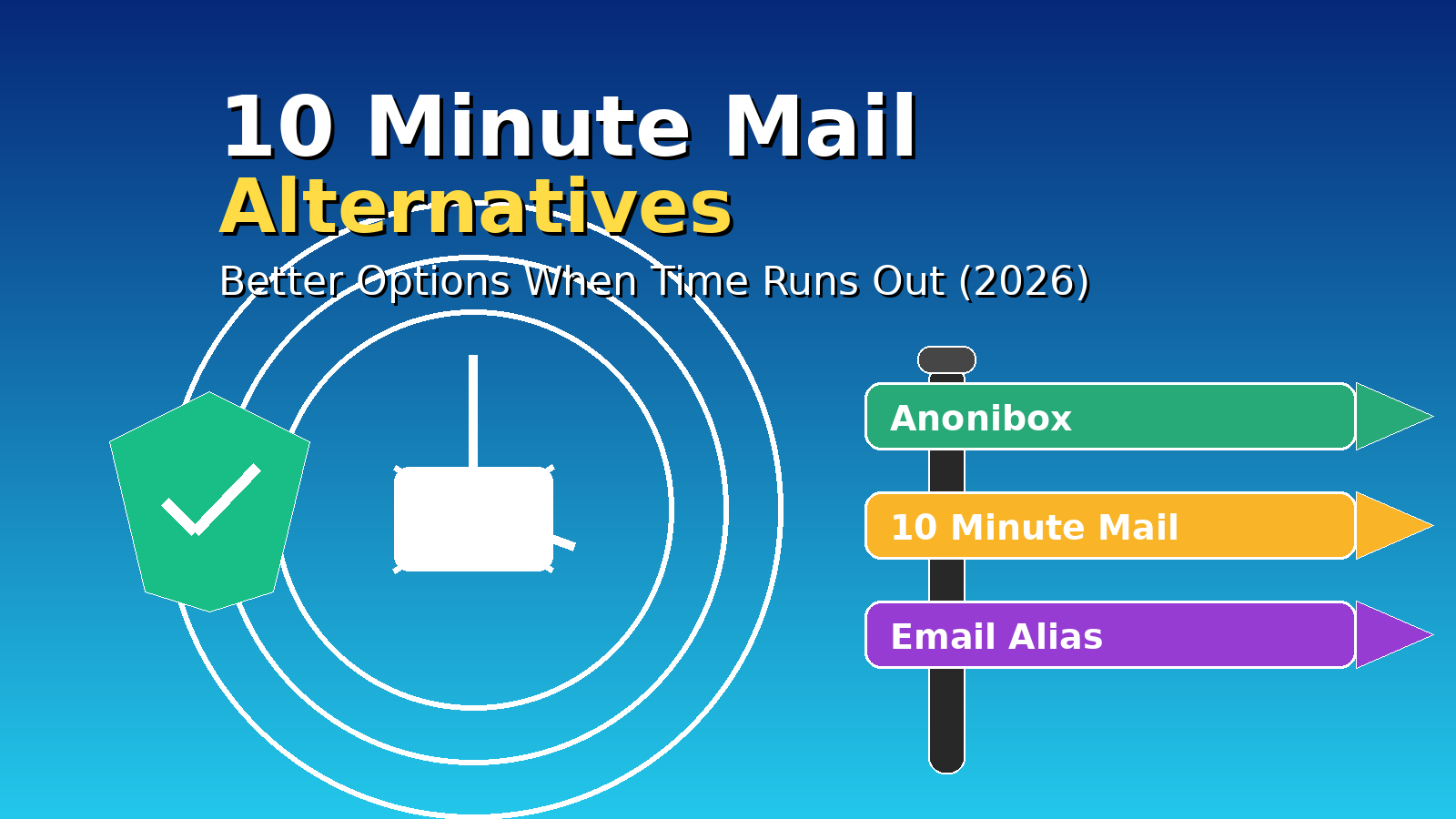
  • 10 Minute Mail Alternative (2026): 9 Better Options for OTP Codes & Quick Signups

    10 Minute Mail Alternative (2026): 9 Better Options for OTP Codes & Quick Signups

    Updated January 2026.

    If you’re searching for a 10 Minute Mail alternative, you’re usually in a hurry. You need a short‑lived inbox to receive a verification code (OTP) or a confirmation link, and you need it before the timer expires.

    For the fastest “generate → receive → done” workflow, start here: Anonibox temporary email generator. It’s built for one‑off signups and codes with minimal friction.


    Quick picks: best 10 Minute Mail alternative by use case

    If you’re new to disposable email in general, start here: Disposable Email Address: What It Is & When to Use It.


    Why 10‑minute inboxes fail in real life

    10‑minute inboxes are great when everything goes perfectly. But the most common failure mode is simple:

    The message arrives after the inbox expires.

    That can happen for reasons that have nothing to do with you:

    • Sender delays: some platforms queue OTP emails or throttle bursts.
    • Verification systems: strict platforms may block certain disposable domains entirely.
    • Mobile background limits: if your browser tab sleeps, refresh can pause.
    • Timing mismatch: “10 minutes” is often not enough if you’re creating an account, solving a captcha, and waiting for email delivery.

    That’s why many people use a longer‑retention disposable inbox (or an alias) when reliability matters.


    Best 10 Minute Mail alternative for most people: Anonibox

    If your goal is “get the code fast,” a generator‑first workflow beats a countdown timer. That’s the core reason people switch to Anonibox temporary email generator.

    60‑second workflow

    1. Open Anonibox.
    2. Copy the generated address.
    3. Paste it into the signup / verification form.
    4. Keep the inbox tab open until the email arrives.
    5. Copy the OTP or click the confirmation link.
    6. Delete the inbox (or let it expire) when done.

    Important: temporary inboxes are for low‑stakes tasks. For banking, healthcare, government portals, or anything you might need later, use an alias instead: Email Alias (2025).


    9 best 10 Minute Mail alternatives (ranked by intent)

    1) Anonibox (best for fast OTP codes)

    When you’re racing the clock, speed and usability matter most. Start here: Anonibox temporary email generator.

    2) Email Alias (best for accounts you might keep)

    If there’s any chance you’ll need password resets, receipts, or account recovery, disposable email is the wrong tool. An alias keeps you private and recoverable.

    Email Alias (2025)

    3) Disposable Email (best for one‑shot downloads)

    Perfect for “send the download link to your email” gates.

    Disposable Email (2025)

    4) Throwaway Email (best for quick confirmations)

    Same spirit as disposable email: receive, confirm, vanish. Guide: Throwaway Email (2025).

    5) Burner Email (best for trials you might not keep)

    Evaluate tools without tying the trial to your primary identity. If you keep the product, re‑register with an alias.

    Burner Email (2025)

    6) Temporary Email Generator (best all‑rounder explainer)

    If you want the concept + use cases in one place:

    Temporary Email Generator — Fast, Private, Free (2025)

    7) Temporary Email for Wi‑Fi Login (best for captive portals)

    Wi‑Fi portals have their own quirks. Follow an ethical, practical workflow here:

    Temporary Email for Wi‑Fi Login (2025)

    8) If you’re comparing incumbents (use these hubs)

    9) Spam control playbook (when you’re tired of cleanup)

    If your primary inbox is already noisy, the long‑term solution is prevention + cleanup:

    How to stop your email from getting spam


    What to do when a website blocks 10‑minute inboxes

    Some platforms block disposable domains to reduce abuse. When that happens, the right move is not to “bypass it,” but to use the right privacy tool:

    • If you might keep the account: use an email alias.
    • If you only want spam separation: use a dedicated secondary mailbox you control.
    • If the site accepts it: plus addressing (name+tag@domain.com) can work, but many sites reject it too.

    If your verification email doesn’t arrive (do this first)

    Most “code didn’t arrive” issues are one of three things: sender delay, refresh issues, or domain blocking. Try this in order:

    • Wait 30–90 seconds (senders sometimes queue OTP emails).
    • Resend the code once.
    • Keep the inbox tab open (mobile browsers may pause background refresh).
    • Generate a fresh address and retry.
    • If the platform blocks disposable email, use an alias for that account.

    FAQs

    Is 10 Minute Mail safe?

    It’s fine for low‑stakes tasks like one‑time codes and quick signups. Don’t use it for sensitive accounts or anything you might need to recover later.

    What’s the best 10 Minute Mail alternative for OTP codes?

    For fast codes and fewer “timer ran out” failures, use a generator‑first workflow like Anonibox.

    Disposable email vs email alias: which should I choose?

    If you might keep the account, choose an alias. If you only need one message and want minimal residue, choose disposable. Guide: Email Alias (2025).


    Conclusion

    The best 10 Minute Mail alternative depends on what you’re doing:

    • Need a code right now? Use Anonibox temporary email generator.
    • Need recovery later? Use an email alias.
    • Need Wi‑Fi portal access? Use a workflow built for captive portals.

    Start here anytime you need a fast inbox: Anonibox temporary email generator.

  • AdGuard Temp Mail Alternative (2026): 8 Better Options for OTP Codes & Spam Control

    AdGuard Temp Mail Alternative (2026): 8 Better Options for OTP Codes & Spam Control

    Updated January 2026.

    If you’re searching for an AdGuard Temp Mail alternative, you probably want one of two outcomes:

    • Receive a verification code (OTP) or confirmation link without sharing your real email, or
    • Reduce inbox spam from signups, downloads, trials, and “free resource” funnels.

    For the most common use case (fast OTP codes + one‑off signups), start here: Anonibox temporary email generator. It’s built for quick, low‑stakes workflows—generate an address, receive the email, and move on.


    Quick picks: best AdGuard Temp Mail alternative by use case

    If you’re new to the topic, start with the basics first: Disposable Email Address: What It Is & When to Use It.


    What is AdGuard Temp Mail (and why people use it)?

    AdGuard Temp Mail is a temporary email service people use to avoid exposing their primary inbox. It’s commonly chosen because it’s part of the broader AdGuard ecosystem and has a clean “get an address, receive email” workflow.

    Most users don’t switch because they “hate” AdGuard Temp Mail—people switch because they need something slightly different:

    • Different retention expectations (how long messages remain available).
    • More consistent deliverability for verification codes.
    • Fewer blocked domains when signing up on strict platforms.
    • Clearer guidance about what temp mail can and can’t do safely.

    AdGuard Temp Mail vs alternatives (what matters in real life)

    When you compare temporary email services, don’t just ask “Does it work?” Ask these three questions:

    1. Is it appropriate for my task? (OTP vs long‑term account)
    2. What’s the privacy posture? (public inbox patterns vs disposable vs alias)
    3. What happens if I need recovery later? (password resets, receipts, access links)
    Option Best for Why it’s a good fit When to avoid
    Anonibox OTP codes, confirmations, one‑off signups Fast generator workflow, low friction Long‑term accounts / recovery
    AdGuard Temp Mail General temp inbox use Clean UX in AdGuard ecosystem Sensitive or recoverable accounts
    Email Alias Accounts you might keep Forwarding/masking + recoverability Instant throwaway tasks
    10 Minute Email Wi‑Fi/captive portals Strict timer reduces residue Slow senders / delayed OTPs

    If you want the full “temporary / throwaway / disposable / burner” map, bookmark: Temp Mail (2025): The Ultimate Guide.


    Best AdGuard Temp Mail alternative for most people: Anonibox

    If your goal is simple—get the code, confirm the link, avoid spam—the best alternative is the one optimized for speed. That’s why most people end up preferring a generator‑first workflow like Anonibox temporary email generator.

    60‑second workflow (copy/paste friendly)

    1. Open Anonibox.
    2. Copy the generated email address.
    3. Paste it into the signup / verification field.
    4. Keep the inbox tab open and wait for the email.
    5. Copy the OTP or click the confirmation link.
    6. Delete the inbox (or let it expire) when you’re done.

    Important: temporary inboxes are for low‑stakes tasks. For banking, healthcare, government portals, or anything you might need to recover later, use an alias instead: Email Alias (2025).


    8 AdGuard Temp Mail alternatives (ranked by intent)

    1) Anonibox (best for fast OTP codes)

    If the job is “get a code now,” a fast generator is the best fit. Start here: Anonibox temporary email generator.

    2) Email Alias (best for accounts you might keep)

    Aliases are “privacy with recovery.” If the account matters even slightly, choose an alias and avoid losing access later.

    Email Alias (2025)

    3) 10 Minute Email (best for captive portals)

    Great for airport/café Wi‑Fi and strict time‑boxed tasks. Risk: if the sender is slow, you might miss the message.

    10 Minute Email (2025)

    4) Disposable Email (best for downloads & gated resources)

    Perfect for “get the download link, close the tab, move on.”

    Disposable Email (2025)

    5) Burner Email (best for trials you might not keep)

    Burner emails are great for evaluating tools without tying the trial to your primary identity. If you keep the product, re‑register with an alias.

    Burner Email (2025)

    6) Throwaway Email (best for quick confirmations)

    If you want a plain‑English guide to legitimate throwaway workflows, start here:

    Throwaway Email (2025)

    7) Maildrop Alternative (best if you specifically like mailbox-style temp mail)

    If you’re comparing “mailbox-style” services, see our complete comparison hub:

    Maildrop Alternative (2026)

    8) Temp‑Mail.org Alternative (best if you’re comparing major incumbents)

    For a broader shortlist against the biggest player in the space:

    Temp‑Mail.org Alternative (2026)


    What to do if a website blocks AdGuard Temp Mail (or any disposable domain)

    Some platforms reject disposable domains to reduce abuse and automated signups. When that happens, the right move is not to “bypass it,” but to choose a different identity tool:

    • If you might keep the account: use an email alias.
    • If you just want spam separation: use a dedicated secondary mailbox you control.
    • If the site accepts it: plus addressing (name+tag@domain.com) sometimes works, but many sites block it too.

    For a broader spam strategy (beyond temp mail), this guide is useful: How to stop your email from getting spam.


    If your verification email doesn’t arrive: troubleshoot in this order

    Most “where is my code?” issues fall into one of these categories: sender delay, refresh issues, or outright domain blocking. Try this in order:

    • Wait 30–90 seconds (some senders queue OTP emails).
    • Resend the code once.
    • Keep the inbox tab open (mobile browsers may pause background refresh).
    • Generate a fresh address and retry.
    • If the platform blocks disposable email, switch to an alias for that account.

    FAQs

    Is AdGuard Temp Mail safe?

    Temp mail is safest for low‑stakes tasks (verification codes, quick signups, one‑shot downloads). Don’t use it for sensitive accounts or anything you may need later. Use an alias when recovery matters.

    Is using an AdGuard Temp Mail alternative legal?

    Yes—temporary email and aliases are legitimate privacy tools. The line is crossed when someone uses them for fraud, harassment, or violating platform rules.

    What is the best AdGuard Temp Mail alternative for OTP codes?

    For fast OTP codes and one‑off signups, a generator-first workflow like Anonibox is usually the simplest choice.

    Disposable email vs email alias: which should I choose?

    If you might keep the account, choose an alias. If you only need one message and you want minimal residue, choose disposable. See: Email Alias (2025).


    Conclusion

    The best AdGuard Temp Mail alternative depends on intent:

    Recommended next reads:

  • Maildrop Alternative (2026): 7 Better Options for Disposable Email & Spam Control

    Maildrop Alternative (2026): 7 Better Options for Disposable Email & Spam Control

    Updated January 2026.

    If you’re searching for a Maildrop alternative, you’re usually trying to solve one of these problems:

    • Get a verification code without handing your real email to a marketing funnel.
    • Protect your primary inbox from spam, tracking pixels, and data broker lists.
    • Test a signup flow (QA/dev) without creating real accounts.

    For the most common use case (fast OTP codes and one‑off signups), start here: Anonibox temporary email generator. Generate an address, receive the message, and move on—no registration required.


    Quick picks: the best Maildrop alternative by use case

    If you’re new to the concept, start with: Disposable Email Address: What It Is & When to Use It.


    What is Maildrop—and what should you know before you use it?

    Maildrop is a free disposable email service where you can invent an address on the @maildrop.cc domain, then view that mailbox in a browser. It’s popular because it’s frictionless: no signup, no passwords, and it “just works” for many low‑stakes tasks.

    But here’s the part many people miss: Maildrop is not built like a private mailbox. On its own documentation pages, it describes itself as designed for no security and little to no privacy. In other words: treat it like a public-ish drop box, not a secure inbox. That doesn’t make it “bad”—it just defines the right (and wrong) use cases.

    Maildrop is fine for

    • one‑time signups that you don’t care about later,
    • receiving a single link or code,
    • quick testing where the data is not sensitive.

    Maildrop is not appropriate for

    • banking, healthcare, taxes, legal portals, or government logins,
    • anything you might need to recover later,
    • sensitive personal information,
    • any activity that violates a platform’s rules.

    If you need a recoverable identity with a kill switch, use an alias instead: Email Alias (2025).


    Maildrop vs better alternatives (real‑world comparison)

    When people compare disposable email services, they usually focus on “Does it work?” The better question is:

    Does it work for my use case with the privacy trade‑offs I’m willing to accept?

    Option Best for Privacy posture When to avoid
    Anonibox OTP codes, confirmations, one‑off signups Designed for quick, low‑footprint use Long‑term accounts/recovery
    Maildrop Basic disposable inbox tasks Self‑described as “no security / little privacy” Sensitive data, anything you may need later
    Email Alias Accounts you might keep Forwarding/masking + control Instant throwaway tasks
    10 Minute Email Wi‑Fi gates & strict time boxes Short retention by design Slow senders / delayed OTPs

    For a deeper primer on all the related terms (temporary, throwaway, burner, etc.), see: Temp Mail (2025): The Ultimate Guide.


    Best Maildrop alternative for most people: Anonibox

    If your goal is simple—get the code, avoid spam, don’t create an account—then a disposable generator built for speed is the best fit. That’s what Anonibox is optimized for: Anonibox temporary email generator.

    60‑second workflow

    1. Open Anonibox.
    2. Copy the generated address.
    3. Paste it into the signup / verification form.
    4. Keep the inbox tab open until the message arrives.
    5. Copy the OTP or click the confirmation link.
    6. Delete the inbox (or let it expire) when you’re done.

    Pro tip: If you’re doing multiple signups in a row, rotate addresses. New signup → new inbox. Compartmentalization is how you keep spam from “following you home.”


    7 Maildrop alternatives (ranked by intent)

    1) Anonibox (best for fast OTP codes & one‑off signups)

    Use this when you want speed and minimal friction. It’s the simplest path for “I need a code right now.” Start here: Anonibox temporary email generator.

    2) Email Alias (best for accounts you might keep)

    If there’s any chance you’ll need password resets, receipts, replies, or recovery later, disposable email is the wrong tool. An alias keeps your primary inbox private while staying recoverable.

    Email Alias (2025): What It Is & When to Use It

    3) 10 Minute Email (best for Wi‑Fi/captive portals)

    When your session is truly time‑boxed, short retention is a feature. Great for airport/café Wi‑Fi gates and one‑shot access links.

    10 Minute Email (2025)

    4) Disposable Email (best for one‑shot downloads)

    This is the classic “get the PDF link, close the tab, move on” workflow. Ideal for whitepapers, coupon unlocks, and gated resources.

    Disposable Email (2025)

    5) Throwaway Email (best for quick confirmations)

    Throwaway email is basically the same mindset as disposable: receive, confirm, vanish. If you want a plain‑English guide with legitimate use cases, start here:

    Throwaway Email (2025)

    6) Burner Email (best for trials you might not keep)

    Burner emails are great for evaluating tools without tying the trial to your primary identity. If you keep the product long‑term, re‑register with an alias.

    Burner Email (2025)

    7) Disposable Temporary Email (best for learning the whole ecosystem)

    If you want the most complete “how it all fits together” guide, this one maps the terms and the real‑world workflows:

    Disposable Temporary Email (2025)


    What to do when a website blocks @maildrop.cc (or any disposable domain)

    Some platforms block disposable domains to reduce automated signups and abuse. When that happens, the right move is not to “bypass it,” but to choose a more appropriate identity tool:

    • If you might keep the account: use an email alias.
    • If you just want spam separation: use a dedicated secondary mailbox you control.
    • If you’re only filtering: plus addressing (name+tag@domain.com) can help—unless the site blocks it too.

    This is part of the broader anti‑spam playbook here: How to stop your email from getting spam.


    If your verification email doesn’t arrive: troubleshooting checklist

    Before you start over, run this quick checklist (it solves most “where is my code?” moments):

    • Wait 30–90 seconds (some senders queue OTP emails).
    • Hit “Resend code” once.
    • Keep the inbox tab open (mobile browsers can pause background refresh).
    • Generate a fresh address and try again.
    • If the site blocks disposable email, switch to an alias for that account.

    FAQs

    Is Maildrop safe?

    Maildrop is fine for low‑stakes tasks, but it’s not meant to be a secure private mailbox. If you need privacy, durability, replies, or recovery, use an alias (or another tool designed for that job).

    Is a Maildrop alternative legal?

    Disposable email and aliases are legitimate privacy tools. The line is crossed when someone uses them for fraud, harassment, or breaking a platform’s rules.

    What’s the best Maildrop alternative for verification codes?

    For fast OTP codes and one‑off signups, a disposable generator like Anonibox is the simplest choice.

    Which is better: disposable email or an email alias?

    If you might keep the account, choose an alias. If you only need one message and you want zero residue, choose disposable. This guide explains it clearly: Email Alias (2025).


    Conclusion

    A good Maildrop alternative depends on your intent:

    More reading (highly practical):

  • Guerrilla Mail Alternative (2026): 9 Safer Options for Fast, Private Temp Email

    Guerrilla Mail Alternative (2026): 9 Safer Options for Fast, Private Temp Email

    Updated January 2026.

    Searching for a Guerrilla Mail alternative usually means you want a temporary inbox that’s fast, doesn’t demand sign‑up, and actually receives the verification email you’re waiting on. That’s exactly what disposable email is for—as long as you use it for the right tasks.

    If you want a working temp inbox right now, start here: Anonibox temporary email generator. Generate an address, receive the OTP/confirmation, and move on—no registration required.


    Quick picks: best Guerrilla Mail alternative by use case

    • Fast OTP / one‑off signups: Anonibox
    • Strict time‑boxed needs (Wi‑Fi portals, quick gates): 10‑minute inbox style tools
    • Software testing (QA/dev): testing inbox platforms with private workflows
    • Accounts you might keep: an email alias (recoverable)

    If you’re new to disposable email, this is the best starting explainer: Disposable Email Address: What It Is & When to Use It.


    Guerrilla Mail vs modern alternatives (what matters in real life)

    Most people choose Guerrilla Mail because it’s simple and familiar. But “simple” isn’t the same as “best,” especially if you care about speed, deliverability consistency, and the privacy trade‑offs of public inbox patterns.

    Option Best for Signup required? What you get When to avoid
    Anonibox OTP codes, confirmations, one‑off signups No Fast disposable inbox + short retention Long‑term accounts / recovery
    Guerrilla Mail Basic disposable inbox use No Quick mailbox Sensitive accounts or anything you must recover later
    10‑minute inbox style Captive portals / time‑boxed tasks No Hard timer + auto expiry Slow senders (delayed OTP emails)
    Testing inbox platforms QA/dev workflows Sometimes Repeatable test addresses, APIs, private modes (often paid) Personal privacy use
    Email alias Accounts you may keep Yes Forwarding/masking + recovery Instant throwaway tasks

    Want the big picture? This is the most complete guide: Temp Mail (2025): The Ultimate Guide.

    Why people switch from Guerrilla Mail

    People don’t search “Guerrilla Mail alternative” for fun—they do it because something went wrong:

    • Verification codes didn’t arrive (or arrived late).
    • A website blocks disposable domains.
    • They want clearer retention expectations (how long messages stick around).
    • They want cleaner UX (copy, refresh, mobile).

    That’s why we recommend picking the tool based on your task, not brand familiarity.


    Best Guerrilla Mail alternative for most people: Anonibox

    If your goal is simple—get the code, confirm the link, don’t get spammed—Anonibox is the most straightforward choice: Anonibox temporary email generator.

    How to use Anonibox (60 seconds)

    1. Open Anonibox.
    2. Copy the generated email address.
    3. Paste it into the signup / verification form.
    4. Keep the inbox tab open until the email arrives.
    5. Copy the OTP or click the confirmation link.
    6. Delete the inbox (or let it expire) when you’re done.

    Safety reminder: do not use disposable email for banking, healthcare portals, government logins, or anything you might need to recover later. For those, use an alias: Email Alias (2025).


    Other strong Guerrilla Mail alternatives (pick based on your goal)

    1) Email alias (best for accounts you might keep)

    An alias gives you privacy without burning the bridge—messages still reach your real inbox, and you can recover the account later. If you’re tired of disposable addresses getting blocked, aliases are often the long‑term solution.

    Guide: Email Alias (2025).

    2) 10‑minute inbox style tools (best for Wi‑Fi portals)

    Perfect for captive portals and quick gates, but risky if the sender delays the message. If this is your use case, follow a safe workflow here:

    Temporary Email for Wi‑Fi Login (2025)

    3) “Alternative” comparison hubs (when you want a shortlist)

    If you’re also comparing Temp‑Mail or Mailinator, these may help (and will be on your site once published):


    What to do when a site blocks disposable email domains

    Some platforms reject disposable domains to reduce abuse. The right move is not to “bypass it,” but to use a more appropriate privacy tool:

    • If you might keep the account: use an email alias.
    • If you just want spam separation: use a dedicated secondary mailbox you control.
    • If the site accepts it: plus‑addressing (you+tag@domain.com) can sometimes help, but many sites reject it too.

    If your verification email doesn’t arrive (do this first)

    Before you start over, try this checklist:

    • Wait 30–90 seconds (OTP senders sometimes queue emails).
    • Resend the code once.
    • Keep the inbox tab open (mobile browsers may pause refresh in the background).
    • Generate a fresh address and retry.
    • If the platform blocks disposable email, switch to an alias for that account.

    To protect your real inbox long‑term, this guide is worth bookmarking: How to Stop Your Email From Getting Spam.


    FAQs

    Is Guerrilla Mail safe?

    Disposable email is safest when used for low‑stakes tasks (verification codes, quick signups) and not used for sensitive content. If you might need account recovery later, use an alias instead.

    Is using a Guerrilla Mail alternative legal?

    Yes—disposable email and aliases are legitimate privacy tools. Use them ethically and follow platform rules.

    What’s the best Guerrilla Mail alternative for verification codes?

    For fast OTP codes and one‑off signups, use a disposable generator like Anonibox.


    Conclusion

    The best Guerrilla Mail alternative is the one that fits your task:

    • Need a code fast? Use Anonibox temporary email generator.
    • Need a recoverable account? Use an alias.
    • Need QA testing flows? Use a testing inbox platform with private workflows.

    Recommended next reads: